
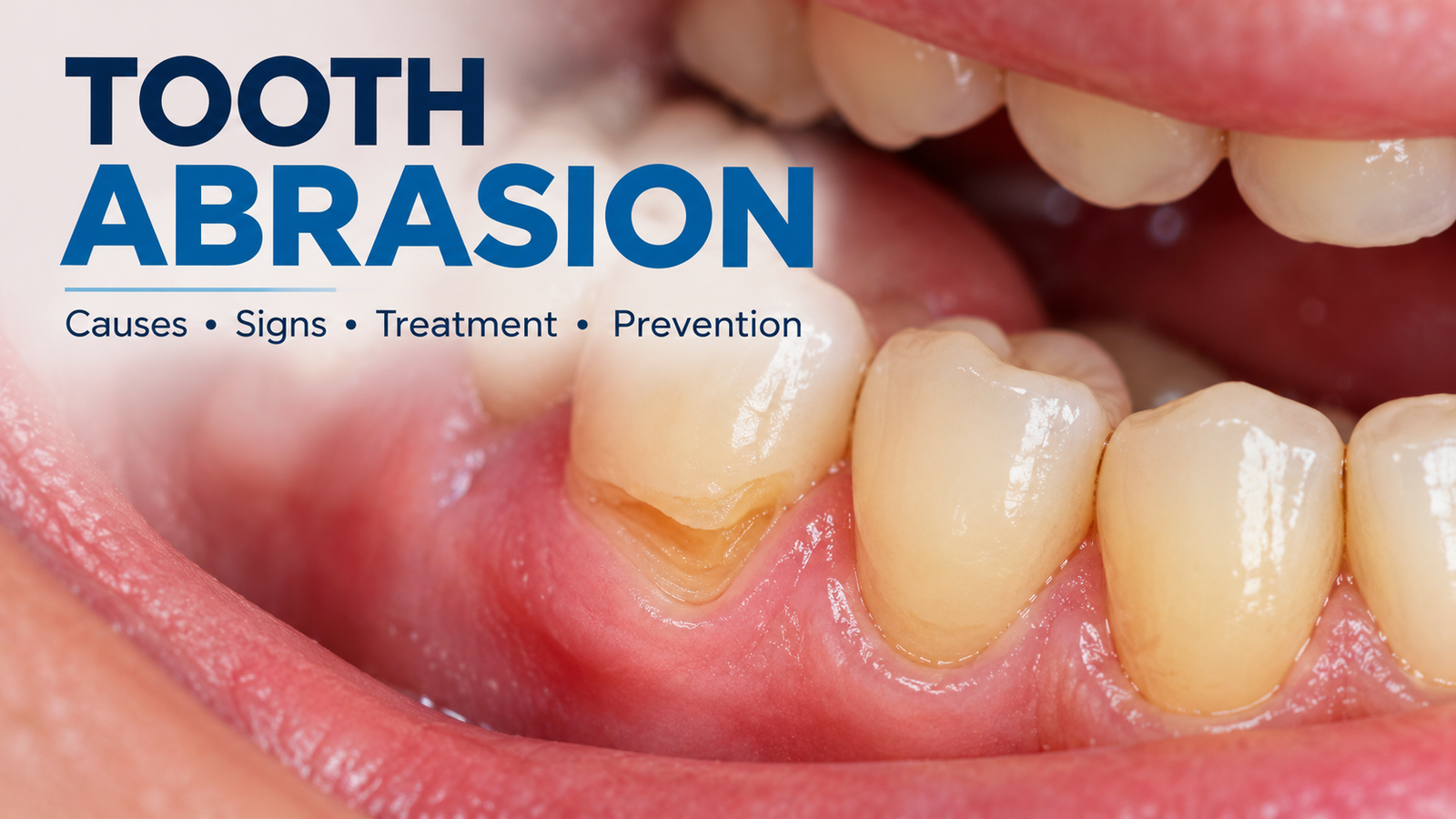
Have you noticed a small groove near your gum line or felt a sharp twinge when brushing your teeth? These changes sometimes indicate Tooth Abrasion, a form of mechanical wear that gradually removes tooth structure. Aggressive brushing, hard-bristled brushes, and repeated friction from cleaning tools are possible causes.
The good news is that early damage often responds well to preventive care. However, lost enamel and dentin do not grow back naturally. A dentist needs to assess deeper grooves, persistent sensitivity, or visible changes in tooth shape to determine whether treatment requires habit changes, desensitizing products, or restorative care.
What happens when tooth structure wears away?
Tooth abrasion develops when repeated friction from an external object removes mineralized tooth tissue. The affected area might involve enamel, the softer dentin beneath it, or exposed root surfaces after gum recession.
The gum line is a common location because the tooth’s cervical area is exposed to brushing forces. When gums recede, root dentin becomes more accessible and wears more easily than enamel.
The process often develops slowly. You might first notice a shallow notch, a yellowish patch, or sensitivity to cold drinks. These signs deserve attention because the affected area might continue to wear even when pain is absent.
A visible groove does not automatically confirm abrasion. Acid exposure, tooth grinding, decay, and changes in the gum line sometimes produce similar findings. A dental examination helps identify the cause before treatment begins.
What causes this type of dental wear?
Brushing with excessive pressure
Scrubbing harder does not necessarily clean teeth better. Heavy pressure, especially with repeated horizontal movements near the gums, increases friction on exposed tooth surfaces.
People often brush aggressively because they want to remove stains or feel cleaner. Unfortunately, excessive force might damage gum tissue and contribute to cervical wear, particularly when dentin is exposed.
Using a hard-bristled toothbrush
Hard bristles are not required for effective plaque removal. A soft-bristled brush with gentle technique cleans teeth while reducing unnecessary trauma to the gums.
Replace a toothbrush when its bristles become frayed or matted. Worn bristles often encourage people to press harder to achieve the same cleaning effect.
Choosing highly abrasive cleaning products
Some whitening pastes, tooth powders, and abrasive home remedies might increase surface wear when combined with aggressive brushing. Risk depends on the product’s abrasivity, brushing pressure, frequency, and the condition of the tooth surface.
Choose a fluoride toothpaste from a reputable manufacturer. If you have exposed roots or existing wear, ask your dentist which formulation suits your needs. Avoid using charcoal powders, household abrasives, or harsh homemade mixtures as substitutes for established oral-care products.
The American Dental Association’s toothpaste guidance explains toothpaste abrasivity and the role of fluoride-containing products.
Using toothpicks or other objects forcefully
Repeatedly pushing toothpicks, fingernails, metal tools, or other objects against teeth might injure the gums and damage exposed surfaces. Use floss or a properly sized interdental cleaner instead of forcing objects into tight spaces.
Repetitive habits
Biting pens, chewing hard objects, holding pins between the teeth, or repeatedly contacting a tooth with another object might contribute to localized wear. The location and pattern of damage help a dentist investigate these habits.
Not every cervical defect results from brushing. Acid-related softening and biting forces sometimes contribute to the same area of tooth wear. A proper diagnosis should consider all relevant factors.
What are the warning signs?
Look for changes around the gum line and on exposed tooth surfaces, including:
- V-shaped or wedge-shaped grooves: A notch appears near the gum line.
- Yellowish areas: Dentin beneath the enamel becomes visible.
- Sensitivity: Cold drinks, hot foods, sweet foods, or brushing trigger discomfort.
- Changes in tooth contour: A previously smooth surface develops a notch or indentation.
- Smooth, polished-looking areas: Repeated friction might leave a shiny surface.
- No obvious pain: Early wear sometimes develops without noticeable symptoms.
Sensitivity deserves attention when it persists, worsens, or affects eating and brushing. A dentist should also examine deepening grooves, exposed roots, suspected decay, or sudden changes in tooth shape.
What does cervical abrasion look like?
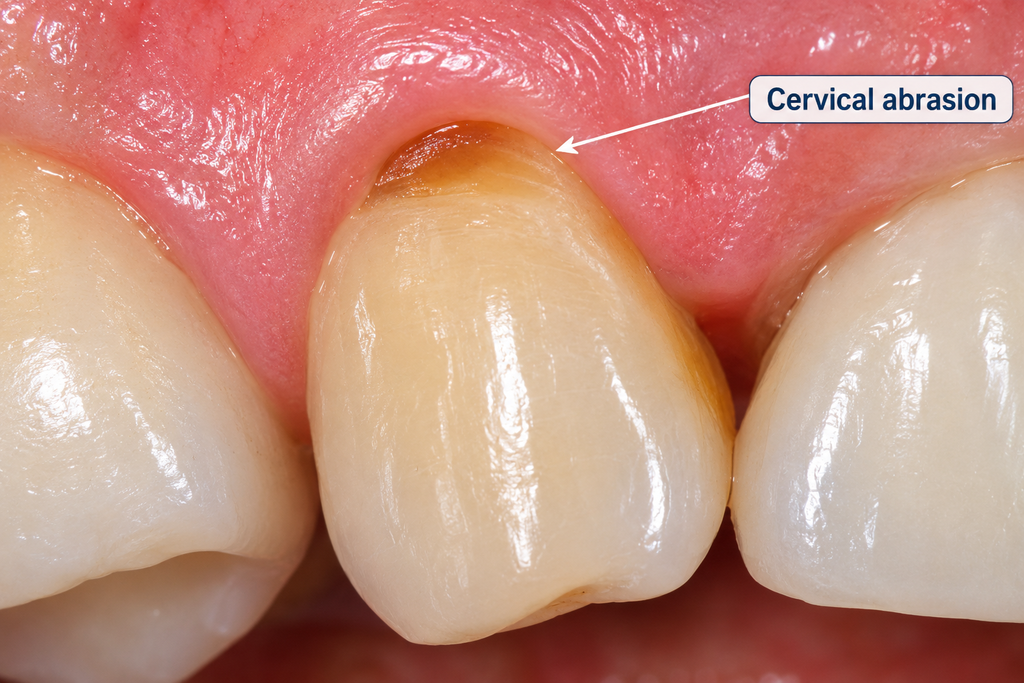
Figure 1. Educational illustration of cervical abrasion. The labeled notch represents tooth structure loss near the gum line. This illustration supports education and does not establish a diagnosis for an individual patient.
A typical cervical defect appears near the junction of the visible crown and the gum line. It might look wedge-shaped, shallow, or irregular. Exposed dentin often appears more yellow than surrounding enamel.
Dentists examine the defect’s shape, depth, surface texture, location, and relationship to the gums. They also ask about brushing technique, diet, reflux, grinding, and sensitivity. Dental X-rays are ordered when clinically indicated, not automatically for every visible groove.
Abrasion vs. erosion vs. attrition
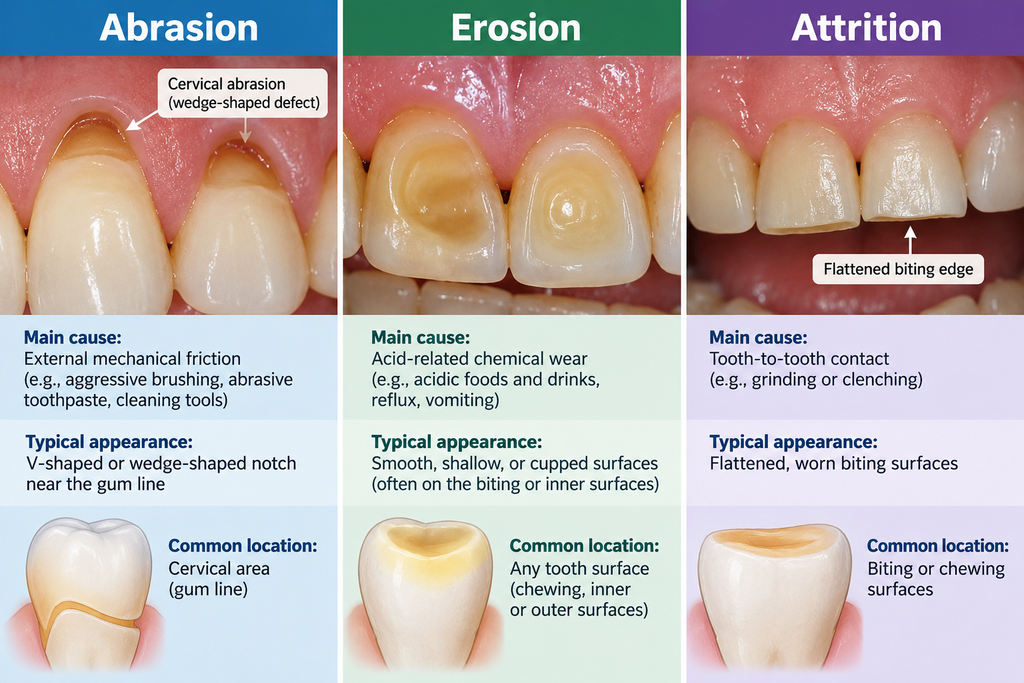
These terms describe different mechanisms of tooth wear. More than one process might affect the same tooth.
| Feature | Abrasion | Erosion | Attrition |
|---|---|---|---|
| Main cause | Mechanical friction from an external object | Chemical dissolution by non-bacterial acids | Tooth-to-tooth contact |
| Typical appearance | Notch or groove, often near the gum line | Smooth, shallow, or cupped surfaces | Flattened biting or chewing surfaces |
| Common contributors | Brushing pressure, abrasive products, repeated object contact | Acidic drinks, reflux, recurrent vomiting | Grinding or clenching |
| Possible symptoms | Sensitivity or visible contour changes | Sensitivity and loss of surface texture | Flattened teeth, wear facets, sometimes jaw discomfort |
| Main response | Reduce friction and protect exposed tissue | Reduce acid exposure and protect the teeth | Assess grinding and biting forces |
The UK government’s tooth-wear guidance defines these mechanisms and discusses risk assessment. Appearance alone does not reliably distinguish them, so professional assessment matters.
How dentists diagnose the problem
Diagnosis begins with your history and a clinical examination. Your dentist might ask:
- How often and how firmly do you brush?
- Which toothbrush and toothpaste do you use?
- Do you consume acidic drinks frequently?
- Do you experience reflux or repeated vomiting?
- Do you grind or clench your teeth?
- Has the groove become deeper or more sensitive?
The dentist then assesses the affected surfaces, gum recession, exposed dentin, existing restorations, and possible decay. Additional tests or X-rays depend on the findings.
The goal is not only to identify existing damage. It is also to determine why the damage occurred and whether the process is still active.
How is Tooth Abrasion treated?
Treatment depends on the defect’s depth, symptoms, appearance, and progression.
Mild wear: Change the cause
For shallow defects without significant structural damage, your dentist might recommend a soft-bristled toothbrush, gentle technique, fluoride toothpaste, and reduced use of abrasive products.
These changes help limit further wear. They do not rebuild tooth tissue already lost.
Sensitivity: Protect exposed surfaces
Desensitizing toothpaste often helps reduce sensitivity when used consistently according to its label. Depending on the clinical findings, a dentist might also apply a professional desensitizing agent or fluoride treatment.
Sensitivity has several possible causes. If symptoms continue despite appropriate home care, an examination is necessary to rule out decay, cracks, or pulp inflammation.
For additional information about fluoride, consult the ADA’s fluoride guidance.
Deeper defects: Restore the missing structure
A deeper cervical notch might need tooth-coloured composite bonding or a filling to restore the contour, cover exposed dentin, reduce sensitivity, or protect weakened tissue.
More extensive damage requires an individualized restorative plan. Not every groove needs a filling. Restoring a tooth without controlling the cause of wear risks further problems around the restoration.
For suitable cases, treatment combines habit correction, symptom management, and restoration when clinically necessary.
Step-by-step brushing checklist
Follow this routine to remove plaque without unnecessary force.
- Choose a soft-bristled toothbrush. Select a head size that reaches the back teeth comfortably.
- Use fluoride toothpaste. Follow the recommended amount for your age and the product instructions.
- Position the brush gently. Angle the bristles toward the gum line, approximately 45 degrees.
- Use short, controlled movements. Clean each area with light pressure rather than forceful horizontal scrubbing.
- Clean every surface. Brush the outer, inner, and chewing surfaces. Tilt the brush vertically to clean behind the front teeth.
- Brush for two minutes, twice daily. A powered toothbrush with a pressure sensor might help if you tend to brush too hard.
- Clean between your teeth daily. Use floss or an appropriate interdental cleaner without forcing it into the gums.
- Replace worn bristles. Change your toothbrush about every three to four months, or earlier if the bristles become frayed.
The ADA’s brushing instructions provide further guidance on technique and toothbrush selection.
Is Tooth Abrasion reversible?
The answer depends on what you mean by reversible.
What can improve:
- Sensitivity might decrease with suitable toothpaste or professional treatment.
- The wearing process often slows or stops when contributing habits are corrected.
- Early mineral changes associated with demineralization might respond to fluoride, depending on the condition.
What cannot grow back:
- Lost enamel does not regenerate naturally.
- Lost dentin does not regrow to restore the original tooth contour.
- A deep groove or notch remains unless a dentist restores the missing structure.
This distinction is important. Preventive care protects what remains, while restorative treatment replaces or covers missing tissue when needed. The appropriate approach depends on the examination, symptoms, and likelihood of further wear.
When should you see a dentist?
Book a dental examination if you notice persistent or increasing sensitivity, a deepening groove near the gum line, yellow dentin, exposed roots, chipping, pain, or rapid changes in tooth shape.
Seek prompt care if pain becomes severe or a tooth appears damaged. Swelling, pus, or fever alongside dental pain also warrants urgent assessment because these signs might indicate infection rather than simple wear.
Do not wait for pain before seeking advice. Early evaluation often makes it easier to identify the cause and protect the remaining tooth structure.
Frequently asked questions
1. What is the main cause of Tooth Abrasion?
Repeated mechanical friction is the defining cause. Aggressive brushing, hard-bristled brushes, abrasive cleaning products, and repeated contact with objects are possible contributors. However, a groove near the gum line might also involve acid erosion, gum recession, or biting forces. A dentist assesses the shape and history before identifying the main cause.
2. Is Tooth Abrasion the same as tooth decay?
No. Abrasion involves mechanical wear, while tooth decay develops when acids produced by plaque bacteria damage tooth structure. Both conditions might cause sensitivity or visible defects, and they can occur together. A dentist distinguishes them through examination and recommends different care depending on the diagnosis.
3. Does brushing too hard damage enamel?
Excessive pressure and aggressive technique contribute to wear, particularly around exposed root surfaces and when abrasive toothpaste is used. Enamel is hard, but it is not indestructible. Use a soft-bristled brush, gentle movements, and fluoride toothpaste. A pressure-sensing electric toothbrush might help people who habitually press too firmly.
4. Is Tooth Abrasion permanent?
Lost enamel or dentin does not grow back naturally, so structural loss is permanent. However, progression often stops when the cause is controlled. Sensitivity might also improve with preventive or professional treatment. Deeper defects sometimes require composite bonding or another restoration to replace missing structure and protect the affected tooth.
5. How do dentists repair Tooth Abrasion?
Treatment ranges from preventive advice and desensitizing products to composite bonding or fillings. The choice depends on defect depth, symptoms, appearance, and progression. A dentist first identifies contributing habits and other forms of tooth wear. Restoring the defect without controlling the cause might allow further damage around the treated area.
6. Which toothbrush is best for preventing Tooth Abrasion?
A soft-bristled toothbrush is the usual recommendation. Choose a head that fits comfortably and lets you reach all tooth surfaces. Manual and electric brushes both work when used correctly. People who press too hard might benefit from an electric model with a pressure sensor and guidance from their dentist.
7. Does Tooth Abrasion cause sensitivity?
Yes. Wear might expose dentin, which contains microscopic tubules connected to the inner part of the tooth. Cold, heat, sweet foods, or brushing can then trigger discomfort. Sensitivity also occurs with decay, cracks, erosion, and gum recession, so persistent symptoms need professional assessment rather than self-diagnosis.
8. How do you stop Tooth Abrasion from getting worse?
Use a soft-bristled toothbrush, apply gentle pressure, and avoid aggressive scrubbing. Choose fluoride toothpaste, limit unnecessary abrasive products, and avoid forceful use of toothpicks or other objects. Address acidic exposure when present and attend dental reviews so your dentist can monitor existing defects and recommend treatment if wear progresses.
Final advice
A small groove near the gum line might appear harmless, but it deserves attention when it deepens or becomes sensitive. Good brushing habits, suitable toothpaste, and regular dental reviews help protect the tooth structure that remains.
If you already have a visible notch, persistent sensitivity, or exposed dentin, arrange a dental examination. The best plan addresses the cause first and restores missing structure only when the clinical findings justify it.
For more general dental education, visit iDentalFix.