
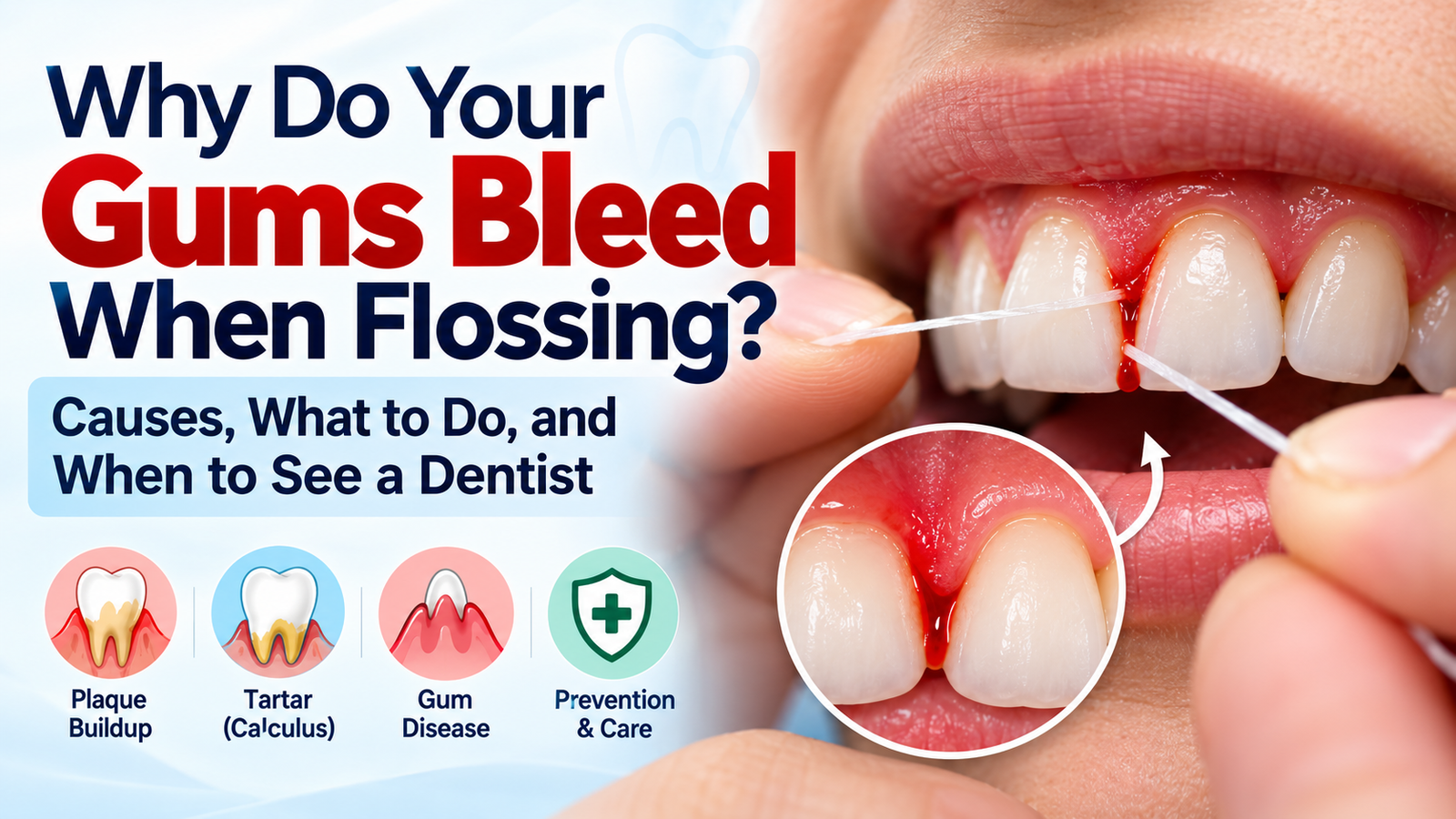
Seeing blood on your floss can be alarming. Many people immediately assume they have injured their gums and stop flossing.
In many cases, this is the wrong response.
Bleeding during flossing often means the gum tissue is inflamed. The most common cause is plaque accumulating around and between the teeth. When plaque remains in place, it irritates the gingival tissue and can lead to gingivitis, the early stage of gum disease.
The important question is not simply, “Why did my gums bleed today?”
The better question is, “Why are my gums bleeding when they are cleaned?”
Understanding the difference helps you decide whether you need to improve your home-care routine or arrange a dental examination.
The Real Reason Your Gums Bleed (And Why You Shouldn’t Stop Flossing)
Healthy gingiva generally should not bleed during routine brushing or interdental cleaning.
When plaque accumulates near the gum margin, bacteria trigger an inflammatory response. The gum tissue becomes more vascular and fragile. As a result, even gentle contact from floss or a toothbrush may cause bleeding.
This is one reason bleeding gums should not automatically be interpreted as evidence that flossing is damaging your gums.
In fact, stopping interdental cleaning because your gums bleed often leaves the plaque responsible for the inflammation in place. Daily interdental cleaning helps remove plaque and debris from areas a toothbrush cannot adequately reach.
The most common cause: plaque-induced gingivitis
Plaque is a soft bacterial biofilm that continuously develops on teeth.
It tends to accumulate in areas where cleaning is difficult, including:
Between adjacent teeth
Along the gumline
Around crowded teeth
Around orthodontic appliances
Around poorly contoured restorations
If plaque remains undisturbed, the surrounding gingiva can become red, swollen and prone to bleeding.
This condition is known as gingivitis.
The good news is that gingivitis is generally reversible when the cause is addressed. The focus is on effective plaque control and professional evaluation when required.
Why your gums might bleed more after you start flossing
Suppose you have not cleaned between your teeth regularly.
You then begin flossing every day.
During the first several days, you notice a small amount of blood.
This does not automatically mean you should stop.
Inflamed gingival tissue often bleeds when it is first disturbed. With consistent and gentle plaque removal, inflammation should improve.
The American Dental Association notes that people who begin a new flossing routine might experience bleeding initially, with the bleeding often settling within about a week. Persistent or concerning bleeding deserves professional evaluation.
Technique matters too.
If you force floss through the contact point and snap it into the gums, you might traumatize the tissue. Floss should pass through the contact carefully and then adapt around the side of each tooth.
Think about cleaning the tooth surface, not cutting into the gum.
When plaque turns into calculus
There is another important distinction.
Plaque is soft and removable with effective daily oral hygiene.
Calculus, also called tartar, is hardened mineralized dental plaque. Once it forms, routine brushing and flossing cannot reliably remove it.
A dental professional needs to remove calculus using professional instrumentation.
This explains why some people floss regularly but continue to experience bleeding.
If calculus is present below or around the gumline, simply changing your flossing technique might not solve the underlying problem.
A dental examination helps determine whether professional cleaning is necessary.
Bleeding gums do not always mean gingivitis
Plaque-induced gingivitis is common, but it is not the only possible explanation.
Other factors associated with bleeding gums include:
Pregnancy-related gingival inflammation
Smoking or tobacco use
Diabetes
Certain medications
Poor plaque control
Crowded or difficult-to-clean teeth
Certain systemic conditions
Nutritional deficiencies
The American Dental Association identifies smoking, genetics, pregnancy, diabetes and several medication groups among factors associated with increased gingivitis risk.
This is why persistent unexplained bleeding should not be treated indefinitely with home remedies.
A dentist needs to assess the clinical situation.
Gingivitis v/s periodontitis
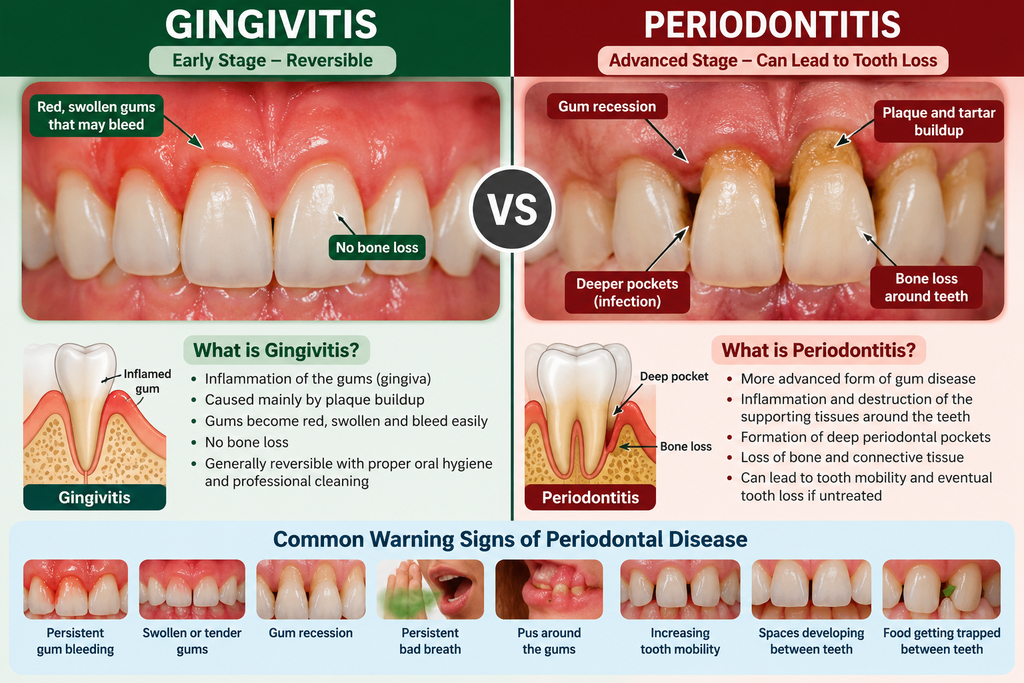
This distinction matters.
Gingivitis primarily involves inflammation of the gingiva. At this stage, the condition is generally reversible.
Periodontitis is more advanced. It involves inflammation and destruction of the supporting tissues around teeth and may eventually contribute to tooth mobility and tooth loss.
Warning signs include:
Persistent gum bleeding
Gum recession
Persistent bad breath
Pus around the gums
Increasing tooth mobility
Changes in the way teeth bite together
Spaces developing between teeth
Food repeatedly getting trapped between particular teeth
The NHS lists bleeding gums, swelling, soreness and bad breath among symptoms of gum disease and advises dental assessment when these symptoms occur.
The Painless Trap: Why Your Gums Bleed But Don’t Hurt
One of the biggest problems with gum disease is that it does not always hurt.
A person might have inflamed gums without significant pain.
This creates a common pattern:
The gums bleed.
The person assumes floss caused it.
Flossing stops.
Plaque remains.
Inflammation continues.
The problem gradually becomes harder to control.
Regular dental examinations help identify periodontal problems before they progress.
How to floss without injuring your gums
Good technique is more important than aggressive technique.
Use a clean section of floss.
Guide the floss gently through the contact point.
Curve the floss around one tooth.
Move it against the tooth surface beneath the gumline without forcing it.
Repeat on the adjacent tooth.
Move to a clean section before cleaning the next area.
Do not repeatedly snap the floss into the gingiva.
If your teeth have larger spaces between them, conventional floss might not be the most appropriate interdental device. Interdental brushes are often useful for open interdental spaces, while floss is useful in tighter contacts. The appropriate method depends on the anatomy of your teeth and gums.
What if regular floss is difficult?
Interdental cleaning does not mean everyone needs to use traditional string floss.
Depending on your mouth, a dentist might recommend:
Dental floss
Interdental brushes
Water flossers
Other specialized interdental cleaners
The American Dental Association recognizes several interdental cleaning options and emphasizes choosing an approach suited to the individual’s needs and interdental anatomy.
This is especially relevant if you have orthodontic appliances, dental bridges, implants, periodontal pockets or larger spaces between teeth.
Should you stop flossing when your gums bleed?
Usually, minor bleeding after beginning a new interdental cleaning routine is not a reason to abandon the habit.
Instead:
Use gentle technique.
Clean between your teeth consistently.
Avoid forcing the floss into the gums.
Monitor whether the bleeding improves.
Arrange a dental examination if bleeding persists, becomes heavy or occurs frequently.
The goal is not to make the gums bleed.
The goal is to remove the plaque contributing to inflammation.
When should you see a dentist?
Make a dental appointment if your gums repeatedly bleed when brushing or flossing.
You should also seek professional assessment if you notice:
Red or swollen gums
Persistent bad breath
Gum recession
Pus around the gums
Loose teeth
Persistent gum tenderness
A bad taste that keeps returning
Bleeding that does not improve with better oral hygiene
The NHS specifically recommends dental assessment for bleeding gums, painful or swollen gums and persistent bad breath.
Seek more urgent dental care when gum problems are accompanied by severe swelling, significant pain, loose teeth, oral ulcers or a lump in the mouth.
What happens during a dental examination?
Your dentist does more than look for visible blood.
They assess the gums, plaque and calculus levels, tooth surfaces, existing restorations and other risk factors. A periodontal examination might also include measuring the depth of gum pockets and checking for bleeding on probing, attachment loss and tooth mobility.
If calculus or periodontal disease is present, professional treatment might be necessary.
The treatment depends on the diagnosis.
A person with mild gingivitis might need improved home care and professional cleaning.
Someone with periodontitis requires a more detailed periodontal assessment and treatment plan.
Why mouthwash is not the main solution
Mouthwash is sometimes useful as an adjunct to oral hygiene, but it should not be viewed as a substitute for mechanical plaque removal.
If plaque remains attached around the teeth and gumline, simply rinsing the mouth does not solve the underlying mechanical problem.
Your daily routine should focus on:
Twice-daily toothbrushing with fluoride toothpaste.
Daily interdental cleaning.
Regular dental examinations.
Professional removal of calculus when required.
Avoiding tobacco.
Maintaining a balanced diet.
The ADA and NHS both emphasize daily interdental cleaning alongside regular toothbrushing as part of oral care.
A practical 7-day approach if your gums bleed when flossing
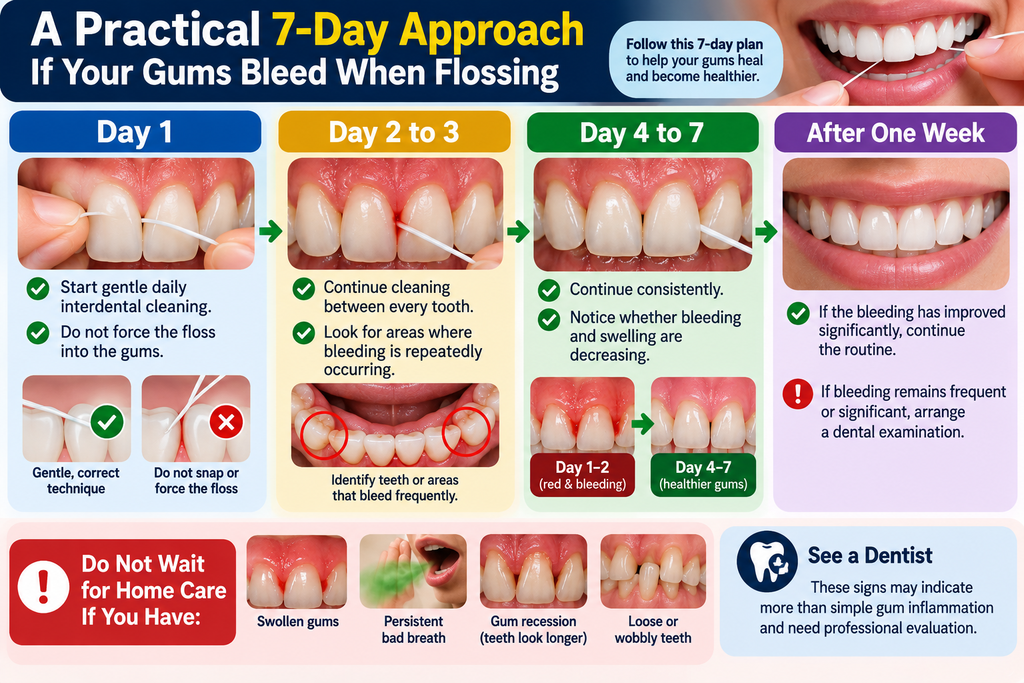
Day 1
Start gentle daily interdental cleaning.
Do not force the floss into the gums.
Day 2 to 3
Continue cleaning between every tooth.
Look for areas where bleeding is repeatedly occurring.
Day 4 to 7
Continue consistently.
Notice whether bleeding and swelling are decreasing.
After one week
If the bleeding has improved significantly, continue the routine.
If bleeding remains frequent or significant, arrange a dental examination.
If you already have swollen gums, persistent bad breath, recession or loose teeth, do not wait for a home-care experiment to resolve the problem.
The bigger lesson about bleeding gums
Bleeding is a symptom, not a diagnosis.
For many people, it points toward gingival inflammation caused by plaque.
For others, it might reflect calculus, tobacco use, hormonal changes, medication effects or another underlying issue.
The mistake is to focus only on stopping the bleeding.
The real goal is to identify why the tissue is bleeding.
Healthy gums should be able to tolerate normal brushing and interdental cleaning without routinely bleeding. If they do not, your mouth is giving you information worth paying attention to.
If you are searching for a dentist near me because your gums bleed every time you brush or floss, do not wait until the problem becomes painful. Gum disease often progresses without significant pain, so early assessment gives you a better opportunity to address the cause before more advanced periodontal damage develops.
Frequently Asked Questions
Is it normal for gums to bleed when flossing?
Occasional bleeding after starting a new flossing routine might occur, especially when the gums are inflamed. If bleeding persists or occurs regularly, arrange a dental examination.
Should I keep flossing if my gums bleed?
In most situations, gentle daily interdental cleaning should continue rather than being abandoned because of minor initial bleeding. Incorrect or forceful technique should be corrected.
How long does bleeding from new flossing last?
The ADA’s patient guidance states that bleeding after starting a new flossing routine often settles within about a week. Persistent bleeding needs dental assessment.
Can flossing damage your gums?
Aggressive flossing or snapping floss into the gingiva can traumatize gum tissue. Proper flossing uses controlled movements and adapts the floss around the tooth.
Can gingivitis cause bleeding while flossing?
Yes. Bleeding gums are a common sign of gingivitis, along with redness, swelling and tenderness. Gingivitis is generally reversible when the underlying inflammation is addressed.
Can tartar cause bleeding gums?
Yes. Calculus provides a plaque-retentive surface and is associated with gingival inflammation. Hardened calculus requires professional removal.
When should I worry about bleeding gums?
Repeated bleeding, swollen gums, persistent bad breath, gum recession, pus, loose teeth or symptoms that do not improve with appropriate oral hygiene warrant professional assessment.
Do I need a dentist if my gums bleed but do not hurt?
Yes, especially if the bleeding happens regularly. Gum disease often produces few symptoms of pain, so absence of pain does not rule out periodontal disease.
Final takeaway
If your gums bleed when you floss, do not automatically blame the floss.
Look at the gums.
Look at your cleaning routine.
Look for plaque and calculus.
Consider your risk factors.
And pay attention to whether the bleeding continues.
A small amount of bleeding after starting interdental cleaning might reflect existing inflammation. Persistent bleeding deserves a professional examination because it might be an early sign of gum disease.
Good oral hygiene is not about avoiding every instance of bleeding. It is about keeping the bacterial biofilm under control and maintaining healthy gum tissue over time.
External links
American Dental Association, flossing and interdental cleaning:
ADA: Floss and Other Interdental Cleaners
American Dental Association, periodontitis:
ADA: Periodontitis
NHS, gum disease:
NHS: Gum Disease
Colgate source article:
Colgate: Do Your Gums Bleed When Flossing?
iDentalFix Article on Root Canal Treatment
2 thoughts on “Why Do Your Gums Bleed When Flossing? Causes, What to Do, and When to See a Dentist”